
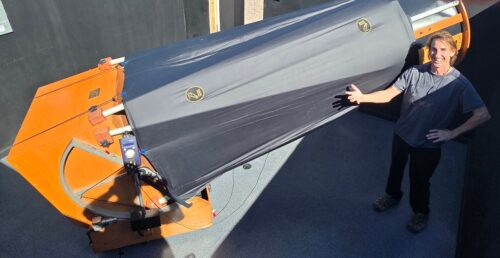
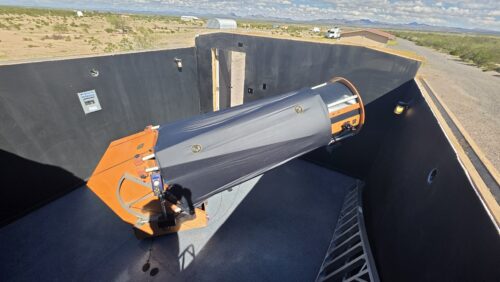
When most people think of remote observatories, they imagine cameras, motors, and data pipelines. But there’s something unbelievably magical about looking through the eyepiece — seeing the sky with your own eyes. Today we’re thrilled to announce that DSP Remote (DSPR), in partnership with Astronomer’s Paradise (AP), has installed a 30″ f/4.5 Obsession Dobsonian for guided, in‑person use by members who visit the site.
This is more than a “pretty amenity” — it’s a statement: we believe in blending cutting-edge remote imaging with the visceral, human thrill of visual astronomy.
Why a 30″ Dobsonian? (And Why Here)
The Appeal of Visual vs. Remote
Visual observation and remote imaging each have their own strengths. Remote imaging offers long exposures, stacking, processing — revealing ultra‑faint galaxies or nebulae to sensors. But visual astronomy connects us emotionally to the sky: the thrill when a galaxy “comes alive” in the eyepiece, the feeling of scale, the immediate feedback.
Why Obsession, Why 30″?
Obsession Telescopes has long been a respected maker of large truss‑Dobsonians. While their standard production line currently goes to 25″, the Obsession 30″ is a rarer, more “prestige” instrument — built for extreme visual performance.
Some interesting specs and contextual insights:
-
The Obsession 30″ is f/4.5 (focal length ~ 3,429 mm)
-
The primary is typically coated with “enhanced” coatings (~96 %) and the secondary with “super enhanced” coatings (~98 %)
-
Eyepiece height at zenith is ~ 335 cm (~11 feet)
-
The limiting visual magnitude is often cited near 17.5 under ideal conditions
-
The Rayleigh resolution limit is about 0.2″ (under perfect seeing)
-
The mirror cell is a 27‑point flotation cell, often with a sling and mirror support system
-
The mirror box alone can weigh ~210 lb in many accounts, and the structure is substantial
-
Due to its rarity (few were made), the 30″ Obsession is somewhat of a “collector’s / extreme hobbyist” instrument in the Dobsonian world.
So this is not your ordinary Dob — it pushes limits, demands respect, and rewards those nights when seeing is exceptional.
What We’ve Built at DSPR / AP
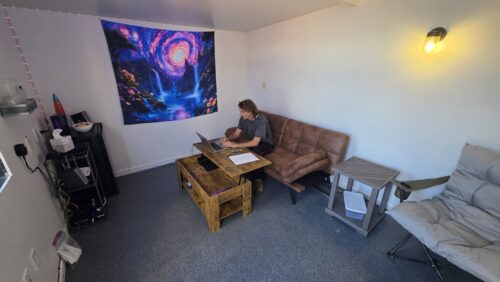
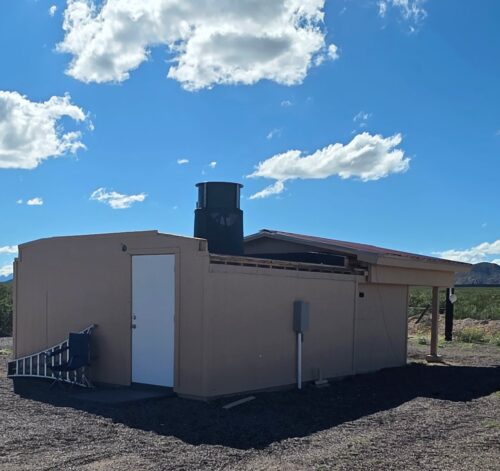
To support this scope in a real, usable way, we didn’t just drop it into the field. We designed a full experience around it. Here’s what visitors can expect:
-
Guided Use Only — Every observing session must be conducted under supervision or guidance by DSPR or AP staff / qualified members. This ensures safety, longevity, and optimal outcomes for both the equipment and users.
-
Warm Room & Amenities — The scope is housed adjacent to a fully furnished warm room, with comfortable seating, ambient music, internet, and a dedicated PC for planning, logging, or sharing views.
-
Sky Conditions & Advantages — Under DSPR’s Bortle 1 skies, the contrast gains and light throughput will maximize what the 30″ can do. For faint deep sky objects, this is a serious jump.
-
Ease-of-Observation Setup — Though the eyepiece height is high (~11 ft at zenith), optimized viewing angles make stellar observing feasible without compromising comfort.
What You’ll See & What It Means
A telescope of this aperture in a pristine dark sky will allow users to:
-
Dive deep into faint galaxies (e.g. low surface brightness structures)
-
Resolve fine detail in planetary nebulae, globular clusters, and faint star clusters
-
Push magnification when seeing allows, revealing subtle features
-
Appreciate the difference between sensor-limited remote exposures and what the sky actually looks like
In short: this gives members both a visceral, memorable night-sky experience and a benchmark for what their remote images represent.
Few Things to Note / Precautions
-
Observing quality is ultimately limited by seeing, transparency, and turbulence. Even the best optics under bad seeing won’t resolve properly.
-
The scope is large and heavy — structural support, safe laddering, and care are essential.
-
Because it’s a shared instrument, scheduling systems will be put in place.
-
Maintenance, cleaning, cooling, collimation, and safety protocols will be stricter than for smaller scopes.
-
It’s not meant to replace remote use — but to complement it. The real power comes when members can compare what they see with what their cameras “see.”
Invitation to Members & Prospects
To all DSPR members (current and prospective): when you next plan a visit, don’t miss the chance to look through the 30″. It’s available for guided use, and we’ll help you get set — ladder, eyepieces, logs, and all. For those who have only known DSPR via remote control, this is your chance to experience our sky directly.
If you’re not yet a member, this is one more reason to choose DSPR — we don’t just host your camera, we host your curiosity. Book your visit, reserve an observing slot, and let us show you what “dark skies” really mean.