
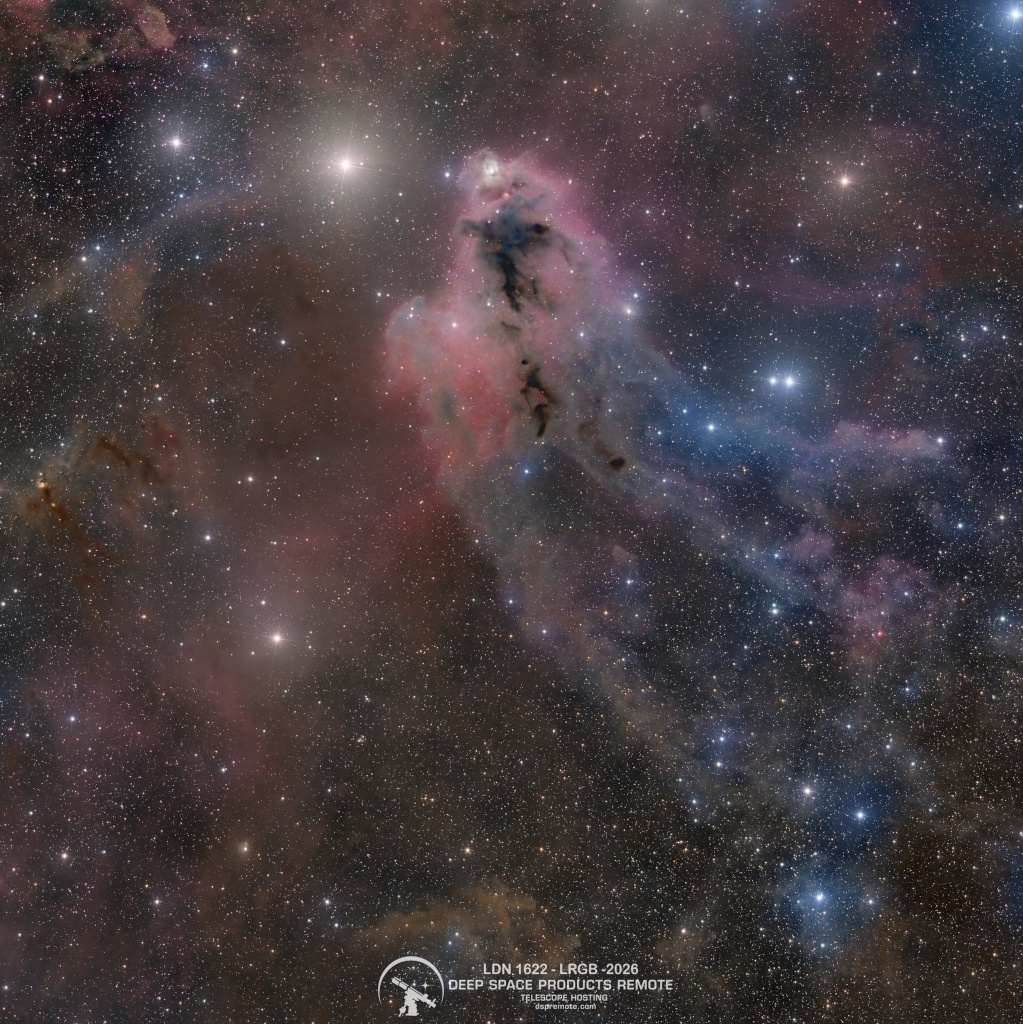
Chris Fellows Earns NASA APOD for LDN 1622 — “Dark Nebula in Orion”
Some achievements feel like a personal milestone. Others feel like a site-wide win.
Today, we’re celebrating DSP Remote member Chris Fellows, whose image “LDN 1622: Dark Nebula in Orion” was selected as NASA’s Astronomy Picture of the Day (APOD) for January 22, 2026. You can view the feature here: https://apod.nasa.gov/apod/ap260122.html.
If you’re newer to deep-sky imaging: APOD is one of the most visible spotlights in astronomy—an image featured daily, paired with a professional astronomer’s write-up, and shared across the community worldwide. Chris’ work earned that stage.
What is LDN 1622, and why is it so hard to image?
LDN 1622 is a dark nebula—a cold, dusty cloud that doesn’t glow brightly on its own. You don’t “see” it by its light… you see it by what it blocks.
It’s a striking silhouette set against a faint background of hydrogen emission (only revealed through long exposure), with vdB 62—a brighter reflection nebula—nearby in the same scene.
That’s the trick: getting enough clean signal in the background to make the dark shape pop—without gradients, haze, or noise burying the subtle contrast.
A real-world example of what dark skies unlock
Targets like LDN 1622 reward two things: truly dark skies and the ability to build clean integration time without fighting gradients, haze, or inconsistent conditions.
In practical terms, an APOD selection like this is a reminder of what becomes possible when your equipment is under Bortle 1 skies and you can reliably accumulate high-quality data over multiple nights. Subtle dust, faint background emission, and fine contrast transitions that get lost at brighter sites start to show up with less noise and less processing “rescue work.”
If you’ve been wondering what remote hosting can unlock—especially for difficult, low-contrast targets—this is a real-world example: patient capture, stable conditions, and dark sky signal that holds up when the stretch gets aggressive.
Congrats, Chris — and thank you for raising the bar
Chris, congratulations from all of us. An APOD selection is earned the hard way: planning, patience, repeatable execution, and the willingness to chase excellence on targets most people scroll past.
Want to see the official feature? Here’s the direct link to the APOD page: https://apod.nasa.gov/apod/ap260122.html.