
A university can run a research or teaching telescope at a remote dark site without building an observatory. The questions that decide whether it works are what the host takes care of, how the cost fits a grant budget, what the sky and uptime data show, and how your team will operate the telescope from campus. This guide answers each one for DSP Remote, with a sample budget.
It's written for department chairs, project PIs and observatory directors who are weighing a hosted pier against a campus dome or a shared regional facility.
Quick facts
- DSP Remote is near Animas, New Mexico, at 4,240 ft under true Bortle 1 skies, with over 286 clear nights a year (site average).
- Median seeing is 1.4 to 1.9 arcsec FWHM at zenith in our spot checks during real imaging sessions, with about 180 nights a year at 2.0 arcsec or better.
- Roof-open hours are logged and published live on our Site Conditions page.
- We serve educators, research teams, and commercial and government projects, with formal service agreements, grant-ready documentation and multi-pier discounts for institutions.
- Agreements can be single-year or multi-year, and the rate is locked for the term.
- Supported equipment includes PlaneWave, ASA, 10Micron, Astro-Physics and Software Bisque, running ACP, NINA, SGP or TheSkyX.
Why would a university host a telescope at a remote site instead of on campus?
Many campuses sit under suburban or city skies (Bortle 6 to 9), and a campus dome sees only a fraction of the clear, dark hours available at a desert site. Hosting moves the telescope to the sky while the students and researchers stay where they are.
A sky that's 3 to 4 magnitudes per square arcsecond darker means roughly 16 to 40 times less sky background. For faint, sky-limited targets, the exposure time needed to reach a given signal-to-noise ratio drops roughly in proportion. Over a semester, that difference decides whether a photometry project produces publishable light curves or a stack of noisy frames.
Hosting also removes the capital project. There's no dome to build, no roof to maintain and no facilities ticket when the shutter motor fails. The trade-off is that someone else's staff handles the hardware, which is why the agreement matters more than the brochure.
What does DSP Remote handle, and what does your team handle?
We look after the site and the physical care of your telescope. Your team owns the instrument, the science, the software setup and the data. Anything specific to your project beyond that, we work out with you directly.
Here's what DSP Remote provides for every hosted telescope:
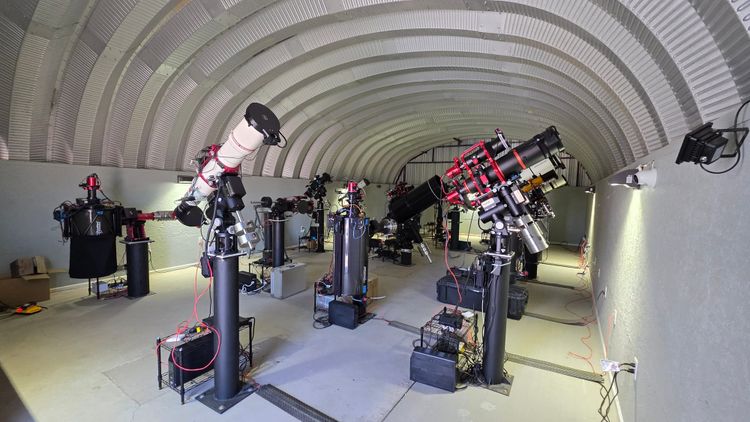
- A custom pier in a fully enclosed observatory, with automated roll-off roofs that open and close based on conditions and time of day. Members get roof status by email or push notification.
- Surge protection and a dedicated multi-dish Starlink connection (quad-dish, expandable to eight dishes).
- Installation your way. Our concierge install ($500 one-time) covers rig setup, cabling, power, camera alignment, flat panel mounting, a collimation check and initial software configuration. Or your faculty can install it themselves, with tools, workspace and our free on-site bunkhouse (reservations required).
- Inspection and cleaning of every hosted telescope every eight weeks, including dust removal and cable checks.
- Remote power cycling and system recovery, and help with firmware and software updates. Scope and mount swaps are available; additional charges may apply.
- 24/7 live observatory camera feeds, optional extra camera angles, and room to add your own pier camera.
- Owner-run support with no ticket queue. Most requests are answered in as little as 15 minutes, up to 24 hours.
Your team brings the telescope and everything that runs on it: shipping the equipment to the site, insuring it (members carry their own policy, which for a university usually goes through the risk management office), software licenses, the observing queue, user accounts, and where the data is stored.
Some details depend on the project rather than a published policy: the terms of an institutional service agreement, multi-pier discounts, access arrangements for your team, data handling, and fit for very large instruments. Ed works those out with each institution, so bring them to the first conversation. The services above are described in more detail on our Install and Maintenance page.
How do you budget a hosted telescope in a grant?
Budget a hosted telescope as a recurring facilities or services line for the full project period, plus one-time costs for shipping, installation and insurance. Because the rate is locked for the term, the hosting line is a fixed number you can justify directly from a quote.
A worked example at DSP Remote's published rates, before any multi-pier discount. Say a three-year project hosts two instruments: a CDK17-class reflector on a premium mount (Large Kit, swing up to 74 in) and a larger reflector on a 10Micron GM3000-class mount (Extra-Large Kit, swing up to 86 in).
| Line item | Calculation | Amount |
|---|---|---|
| Large Kit pier | $500/mo x 36 months | $18,000 |
| Extra-Large Kit pier | $550/mo x 36 months | $19,800 |
| Concierge installation (optional) | $500 one-time x 2 | $1,000 |
| Hosting subtotal at published rates | $38,800 |
Add shipping both ways, equipment insurance from your institution's risk office, and software licenses. Multi-pier discounts for institutions would reduce the hosting lines, so ask for a written quote to use in the budget justification. Your sponsored programs office will also want to know the payment method in advance; we accept check, money order, wire transfer or Zelle.
If you're applying to NSF, check how your program classifies hosting in the current Proposal and Award Policies and Procedures Guide. Hosting fees are usually budgeted as a recurring service rather than equipment, but indirect cost treatment varies by institution, so confirm it with your sponsored programs office.
What site data can DSP Remote provide for a proposal?
We can point you to measured seeing, clear-night statistics and a live uptime log. Reviewers and committees will ask how many usable hours the instrument will deliver, and these give you numbers you can cite.
Here's what we can document. Our spot checks during real imaging sessions show a median seeing of 1.4 to 1.9 arcsec FWHM at zenith, with about 180 nights a year at 2.0 arcsec or better and 40 to 45 nights under 1.3 arcsec. Independent evidence agrees: local measurements 15 miles south show a long-term median of 1.1 to 1.9 arcsec, and Meteoblue's grid model for Animas puts 60 to 65% of clear-sky hours at 1.4 to 2.0 arcsec.
For uptime, our roof-open hours have been logged since July 20, 2023, and the running total is published live on the Site Conditions page alongside the all-sky camera, Clear Sky Chart, Astrospheric, Meteoblue seeing, GOES-19 satellite and wind and radar data. Our Why Choose Us page has more detail on the seeing measurements and on institutional hosting.
How large a telescope can a university host remotely?
At DSP Remote, our published kits go up to an 86-inch swing diameter, which covers top-end mounts such as the 10Micron GM3000 and GM4000 with reflectors up to 24 inches. Larger rigs go into a Custom Kit with at least 12 inches of clearance between neighbors.
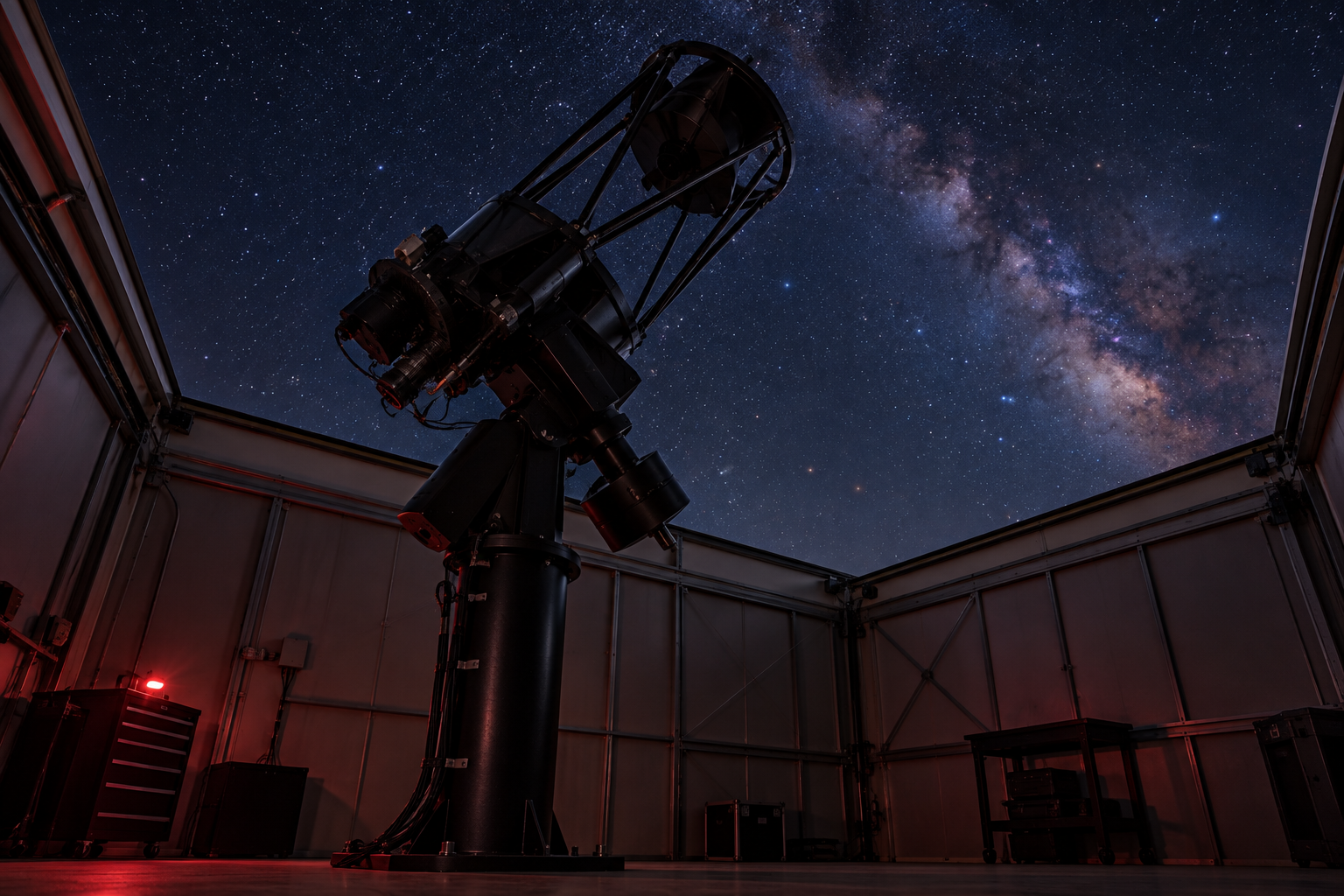
Swing diameter is twice the longest distance from the mount's center of rotation to the furthest part of the rig, plus 1 to 2 inches for cable slack and focuser travel. Your instrument team can calculate it from the mount and OTA drawings, or with the calculator on our Plans and Pricing page.
For multi-pier projects, timing matters. Observatory 20, our large multi-pier building, is currently full. Observatory 21, a second large observatory beside it, is under construction, and as of September 12, 2026 the steel frame, roof and wall panels are up and the slab is poured. Institutions planning more than one pier can contact Ed now to get on the list for opening day. Our post on the new observatory has more on the build.
How do students and research teams operate a hosted telescope?
Students and researchers operate a hosted telescope over the internet with the same control software they'd use on campus, usually through a scheduler that runs the queue unattended. Nobody needs to be on site for a normal night.
For teaching, a common setup is a robotic queue (ACP and similar schedulers are built for this) where students submit targets and receive calibrated frames the next morning, with a live session reserved for class demonstrations. For research, the PI usually controls the queue and the observing log, and data is pulled to university storage each morning. Decide early who holds administrator credentials, how accounts are added and removed each semester, and where the raw data is archived. Those decisions belong in your project plan, and anything that involves the site is worth raising with Ed early.
Our team brings relevant depth here. Chris Fellows, co-founder and technical director, spent 35 years engineering and managing large-scale networks and is on site. Michael Kidd, our chief software engineer and electrical specialist, is a former systems engineer at USJFCOM and IBM software engineer. Ed Thomas has 16+ years of telescope and mount repair, servicing and upgrades. More on the team is on our About page.
Frequently asked questions
Can a university host a research telescope at DSP Remote?
Yes. DSP Remote serves educators, research teams, and commercial and government projects, with formal service agreements, grant-ready documentation and multi-pier discounts for institutions.
How much does it cost to host a university telescope remotely?
Published DSP Remote rates run from $300 to $550 a month per pier by swing diameter, with Custom Kits from $550. Institutions should request a written quote that includes any multi-pier discount.
Can hosting fees be paid from a grant?
Often yes, as a recurring services line, but classification depends on the sponsor and your institution. Agreements can be multi-year with the rate locked, which makes the budget line easy to justify.
Do students need to travel to the site?
No. Telescopes are operated remotely with standard software such as ACP, NINA or TheSkyX. Faculty who install their own equipment can use our free on-site bunkhouse, with reservations.
Who handles hardware problems at a hosted observatory?
At DSP Remote, support is owner-run with no ticket queue. Remote power cycling and system recovery are available, and every hosted telescope is inspected and cleaned every eight weeks.
Talk to Ed about an institutional agreement
If you're planning a proposal, a teaching program or a multi-pier project, the useful next step is a conversation about your instrument, timeline and documentation needs. Contact us to talk to Ed about an institutional agreement, and ask to be added to the Observatory 21 list if you need more than one pier.