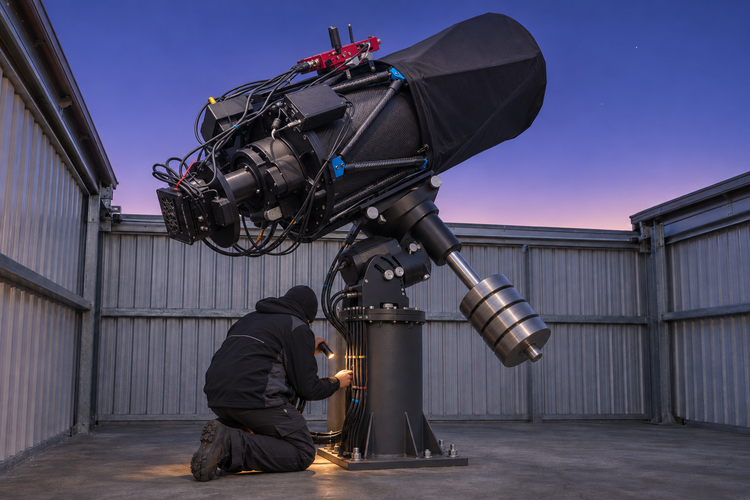

To ship a telescope mount to a remote observatory, pack the mount head, the counterweights and the optical tube in separate double boxes, take out every battery, and insure the shipment for full replacement value. Steel counterweights and glass should never ride in the same box. Before you book a carrier, contact Ed so your rig's arrival lines up with your install.
Ed has spent more than 16 years repairing, servicing and upgrading telescopes and mounts, and Deep Space Products, the business DSP Remote grew out of, is the certified 10Micron service center for North America. A careful pack job costs an afternoon. A cracked corrector or a bent counterweight bar costs a season.
Quick facts
- DSP Remote is near Animas, New Mexico, under true Bortle 1 skies at 4,240 ft.
- Piers are priced by swing diameter, from $300 a month (Small Kit) to $550 a month (Extra-Large Kit), with Custom Kits from $550 a month.
- Concierge install is a $500 one-time add-on (included with select packages): full rig setup, cabling, power, camera alignment, flat panel mounting, a collimation check and initial software configuration.
- Members who install their own rig can stay free in the on-site bunkhouse (reservations required) and use on-site tools and workspace.
- Every hosted telescope gets an inspection and cleaning every eight weeks, included.
- Members can insure their gear with a personal articles policy through their own agent, typically about $1 per $1,000 of equipment per month.
Should you ship your telescope or drive it to the observatory?
If you can drive it, drive it. A rig that rides in your back seat, wrapped in moving blankets and strapped down, skips the conveyor belts and the drop tests entirely. Driving also pairs well with a self-install, since our bunkhouse has a full kitchen, a bathroom and two bedrooms, and members stay free with a reservation.
Shipping makes sense when the drive is two or three days each way, or when you'd rather not spend an install trip away from work. In that case concierge install is the natural fit: your rig arrives, and we set it up, cable it, power it, align the camera, mount the flat panel, check collimation and configure the software. Either way, the packing advice below applies, because even a car trip on a washboard dirt road will find any part you didn't secure.
You can also split the difference: drive out the mount and OTA, which are the expensive and fragile parts, and ship the cables, power hub and spare parts by parcel.
How do you prepare a telescope mount for shipping?
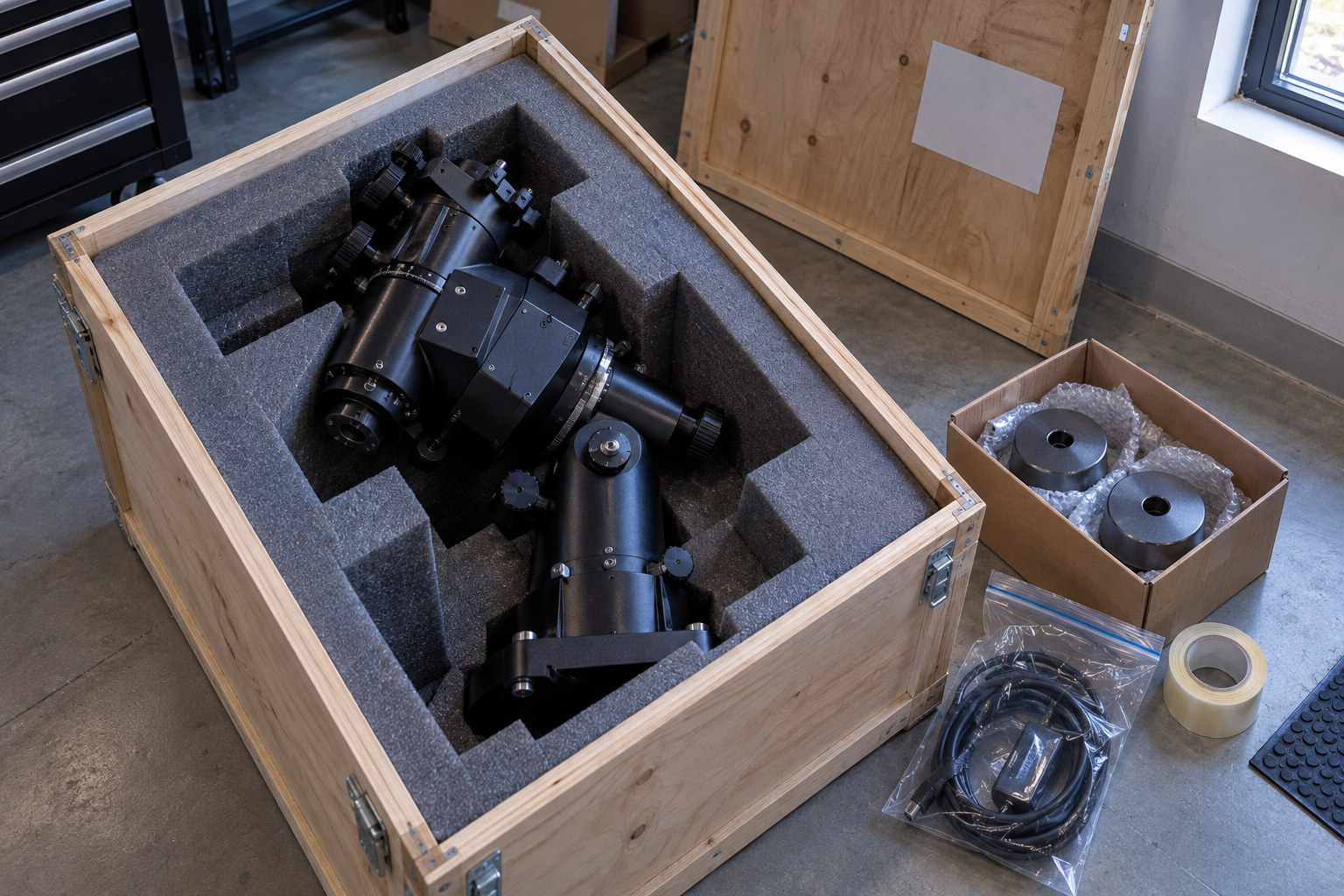
Strip the mount down to the head. Remove the counterweights and the counterweight bar, the dovetail saddle accessories, the hand controller, any GPS module and every cable, then set the axes in the transport position your manual describes. Pull all batteries, including the small clock battery if your manual says it's removable.
A few details matter more than people expect:
- Use the original foam-cut packaging if you still have it. It was designed around that mount's weight and shape, and nothing you improvise will hold it as well.
- Photograph every connector panel and cable run before you unplug anything. Those photos become the cable map for whoever reassembles the rig, whether that's you or us.
- Check that the counterweight bar threads are clean and wrap them so they can't gouge the box or anything else.
- Put a short note inside the box with your name, phone number and the mount model, in case the outer label gets torn off.
- Pack loose screws, Allen keys and the saddle bolts in a labelled zip bag, and tape it to the inside of the box lid.
If you're shipping a 10Micron, follow 10Micron's transport guidance for your model and keep the mount's serial number and firmware version written down. Our 10Micron Advantage page explains why these mounts suit remote work so well, and it's worth reading before you decide what to send.
How do you pack a refractor or reflector OTA for shipping?
Take the camera, filter wheel, off-axis guider and any field flattener off the tube, cap both ends, and lock the focuser. Then wrap the tube in at least 2 inches of foam, put it in a snug inner box, and float that box inside an outer box that's at least 2 inches bigger on every side. That's the double-box method most telescope makers recommend, and it works because the outer box takes the hit and the inner box never feels it.
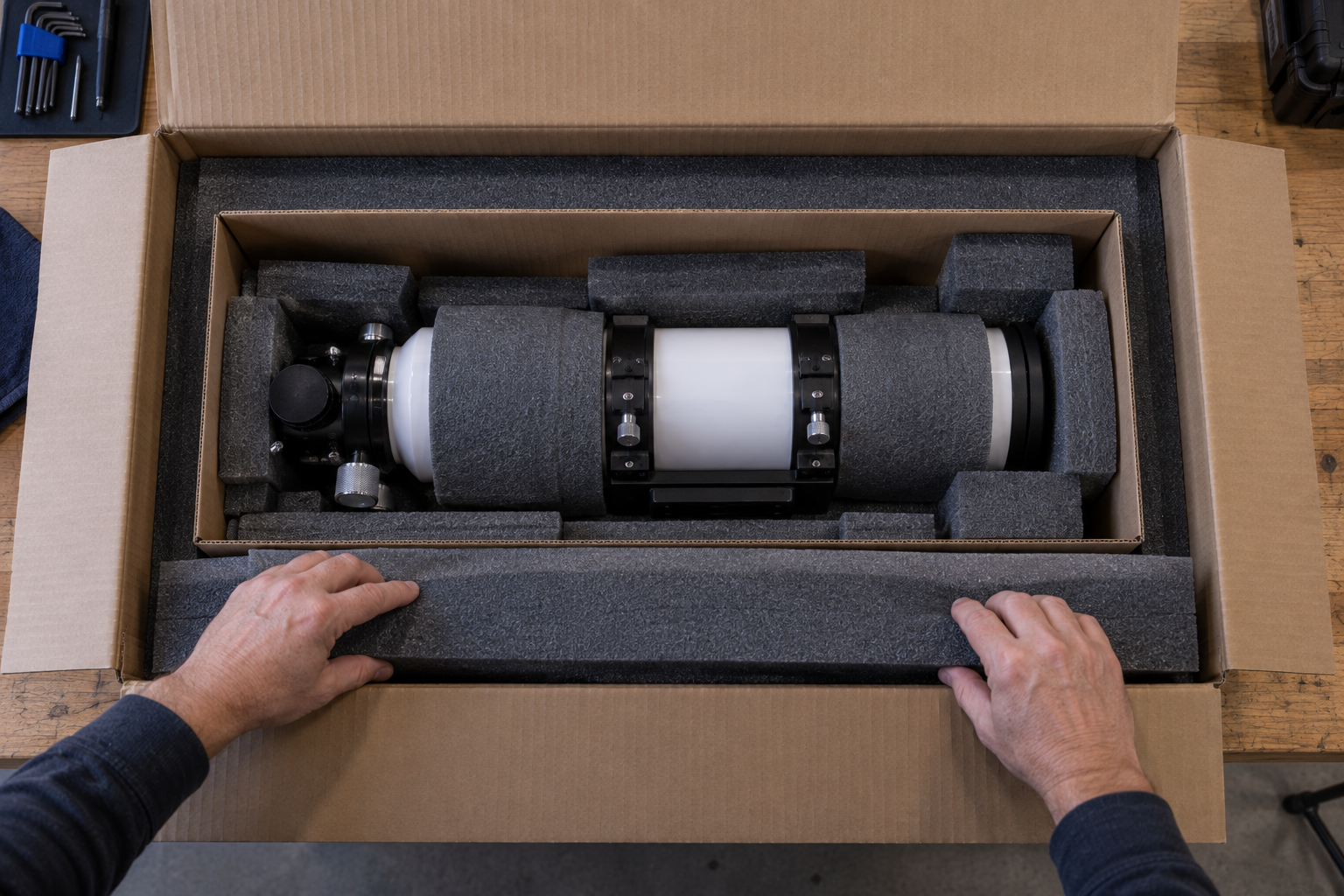
Sky-Watcher USA's packing and shipping instructions set the bar we like: the package should survive a 10 foot fall onto a cinderblock smaller than the box. Foam peanuts don't count, because a heavy tube sinks straight through them.
Different designs need different care:
- Refractors need extra foam in front of the objective, behind the lens cap. The objective cell is the most expensive part of the scope and the part most likely to shift if it takes a hard knock.
- Schmidt-Cassegrains need the corrector plate protected and, on Celestron tubes, the original collimation screws back in place of any thumbscrew knobs. Celestron's shipping guidance explains why: a forward impact can push the cover into the knobs and crack the corrector.
- Newtonians, Ritchey-Chrétiens and corrected Dall-Kirkhams need their primary mirror secured the way the manufacturer specifies. Larger reflectors, up to the CDK17 class, usually travel best in a custom wooden crate lined with foam.
Expect to recheck collimation after any reflector ships, however well it was packed. That's one reason a collimation check is part of our concierge install.
How should you pack the camera, filters and electronics?
Pack the imaging train in its own small box, with each piece in an anti-static bag and a desiccant pack in the box. A cooled camera, a filter wheel full of filters and a power box are light, so they don't need to share space with anything heavy, and they're the easiest parts to lose in a mixed box.
Leave the filters in the wheel if the wheel locks them in place. Label every cable at both ends with the device it runs to, then coil and bag them.
Keep a copy of your NINA, SGP or TheSkyX profile and your mount's site settings on a USB stick taped inside the box, and another copy in your email. If you've chosen concierge install, that profile saves real time during initial software configuration.
What does a box plan look like for a typical rig?
For a 130 mm refractor on a mid-size German equatorial mount, the kind of rig that usually fits our Medium Kit, plan on four boxes. Here's how we'd split it.
| Box | Contents | How to pack it |
|---|---|---|
| 1 | Mount head | Original foam case, or a foam-lined double box. Batteries out, axes in transport position. |
| 2 | Counterweights and counterweight bar | Small, sturdy box, weights wrapped individually so they can't knock together. Never with optics. |
| 3 | Optical tube | Double box, 2 in of foam around the tube, extra foam in front of the objective, focuser locked. |
| 4 | Camera, filter wheel, OAG, flattener, power hub, cables | Anti-static bags, desiccant, every cable labelled at both ends, profile backup on a USB stick. |
Number each box "1 of 4," "2 of 4" and so on, and list the contents on a sheet inside each one. If you're not sure which kit size your rig needs, measure the swing diameter first with the calculator on our Plans and Pricing page. Swing diameter is twice the longest distance from where the RA and Dec axes meet to the furthest part of the rig, plus 1 to 2 inches for cable slack and focuser travel.
Should you ship a telescope by parcel carrier or freight?
Ship by parcel carrier when every box stays under the carrier's weight limit, and by freight when it doesn't. UPS and FedEx Ground both cap a single package at 150 lb, so a small or mid-size rig split into four boxes usually travels by parcel. A large mount head, a heavy counterweight set or a crated reflector usually goes freight on a pallet.
Insurance is where people get caught out. Declare the full replacement value, not what you paid for the gear used, and read the carrier's declared value terms for high-value items before you print labels. Then call your own insurance agent. Members can carry a personal articles policy, which typically runs about $1 per $1,000 of equipment per month, and it's worth confirming with your agent whether that policy covers the rig in transit as well as on the pier.
Take photos of each packed box before you seal it. If anything arrives damaged, those photos make a claim much simpler.
What happens when your rig arrives at DSP Remote?
That depends on whether you're installing it yourself or we are. With concierge install, we do the full setup: mounting, cabling, power, camera alignment, flat panel mounting, a collimation check and initial software configuration. Ed works out arrival and install timing with each member, so contact Ed before you ship anything.
If you're self-installing, book the bunkhouse, plan your trip around the delivery date, and use the on-site tools and workspace. Our Install and Maintenance page covers what's included either way.
After install, your rig gets an inspection and cleaning every eight weeks, with dust removal and cable checks. Remote power cycling, help with firmware and software updates, and later scope or mount swaps are available too (additional charges may apply). Keep your original boxes and foam. You'll want them again if you ever upgrade or bring the rig home.
What should you do the week before you ship?
- Run the whole rig for a full night at home, unattended, from your remote control software.
- Photograph every connector panel, cable run and the balance position of the OTA on the saddle.
- Save your imaging software profile, mount site settings and pointing model notes to a USB stick and to email.
- Strip the mount to the head, pull every battery, and set the transport position from the manual.
- Label every cable at both ends.
- Pack in separate boxes: mount, counterweights, OTA, imaging train and cables.
- Insure for replacement value and confirm transit coverage with your agent.
- Contact Ed with your tracking numbers and box count.
Frequently asked questions
Can I ship a telescope mount in its original box?
Yes, and it's usually the best option. The original foam-cut packaging was designed for that mount's weight and shape. Put it inside a larger outer box with padding for a second layer of protection.
Should counterweights ship in the same box as the mount?
No. Ship counterweights and the counterweight bar in their own small box. Loose steel in a box with a mount head or optics can do serious damage if the box is dropped.
How much does it cost to ship a telescope mount?
It depends on weight, distance and declared value, so get quotes from more than one carrier. Boxes under 150 lb each can go by UPS or FedEx Ground; heavier mounts and crated reflectors usually go by freight.
Do I need to collimate my telescope after shipping?
Reflectors almost always need a collimation check after shipping, and refractors occasionally do. At DSP Remote, a collimation check is part of the $500 concierge install.
Can I install the telescope myself instead of shipping it?
Yes. Members who self-install can stay free in our on-site bunkhouse, with a reservation, and use on-site tools and workspace.
Reserve your pier
Before you pack anything, find your kit size with the swing diameter calculator on our Plans and Pricing page. Our new large observatory is going up beside Observatory 20, and you can contact Ed now to get on the list for opening day. Then reserve your pier, and we'll get your rig under Bortle 1 skies.