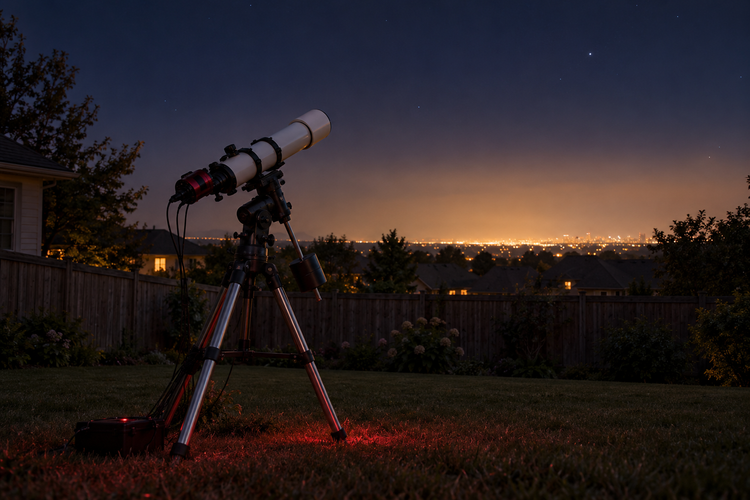

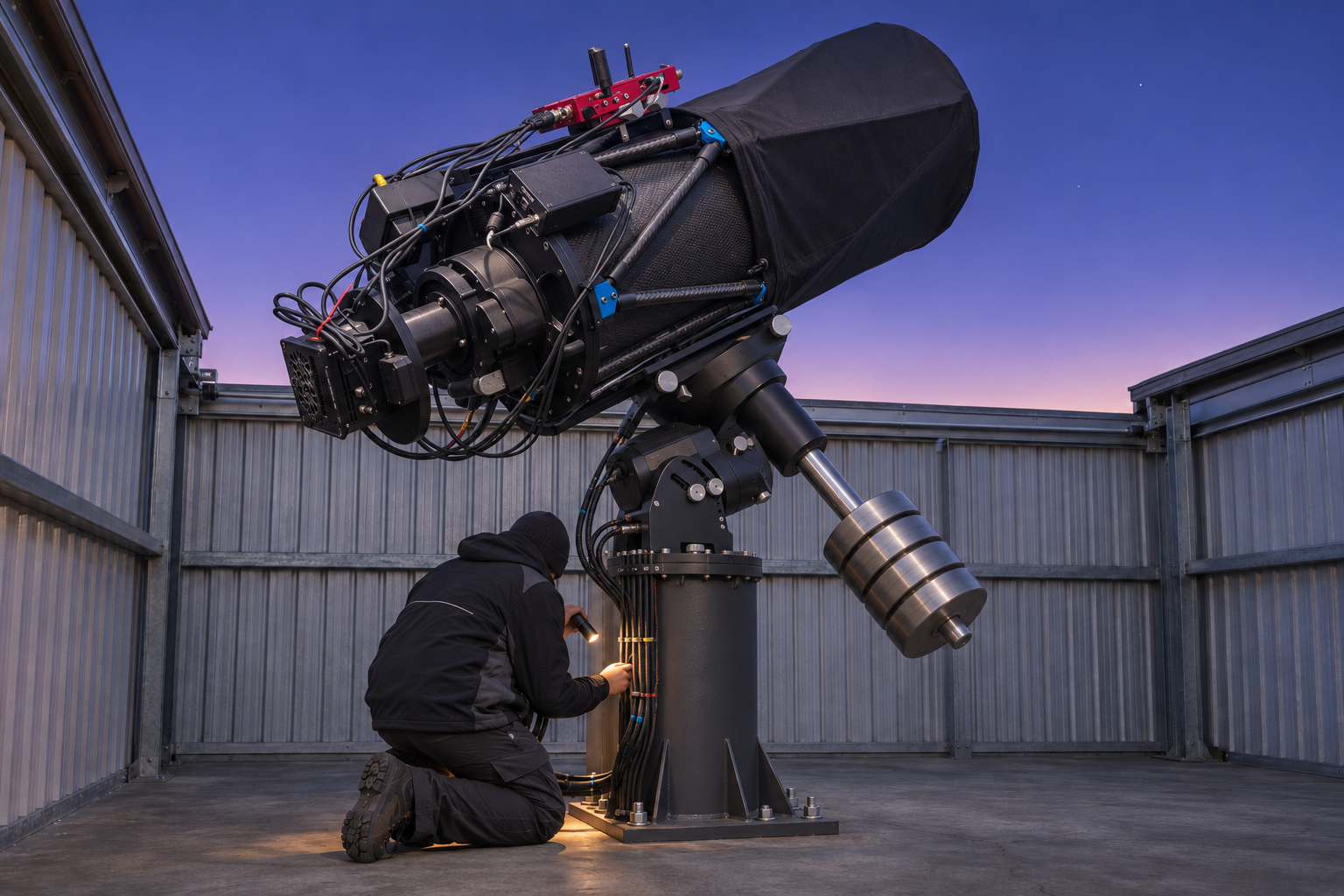
Yes, a 0.5 m class research telescope such as a PlaneWave CDK20 or CDK24 can be hosted at a remote dark site and run from campus. At DSP Remote, our published kits reach reflectors up to 24 inches on an Extra-Large pier, with Custom piers above that. Planning comes down to four things on your side: the rig's swing diameter, matching plate scale to the site's seeing, robotic operation, and how your data gets home.
This guide works through each one with real numbers, written for the PI, observatory director or department chair who has to justify the choice.
Quick facts
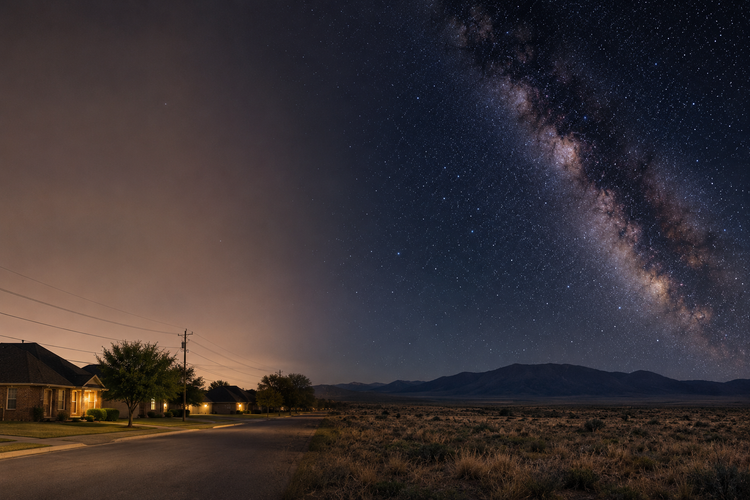
- DSP Remote is near Animas, New Mexico, at 4,240 ft elevation under true Bortle 1 skies, with over 286 clear nights a year (site average).
- Median seeing is 1.4 to 1.9 arcsec FWHM at zenith in our spot checks during real imaging sessions, with about 180 nights a year at 2.0 arcsec or better and 40 to 45 nights under 1.3 arcsec.
- The Extra-Large Kit ($550 a month, swing up to 86 in) covers top-end mounts such as the 10Micron GM3000/4000, Astro-Physics AP1600 and Software Bisque ME, with refractors or reflectors up to 24 in.
- Custom Kits start at $550 a month for rigs with a swing of 86 in or more, with at least 12 in of clearance between neighbors.
- Institutions get formal service agreements and grant-ready documentation.
- Supported equipment includes PlaneWave, ASA, 10Micron, Astro-Physics and Software Bisque, running ACP, NINA, SGP or TheSkyX.
- Ed Thomas also owns Deep Space Products, which sells PlaneWave telescopes including the CDK20 and CDK24 and is the primary U.S. 10Micron dealer and certified 10Micron service center for North America.
Can a 0.5 m research telescope be hosted at a remote site?
Yes. A 0.5 m telescope is a hosting job in the same way a 130 mm refractor is, only with heavier lifting, a bigger swing and more data per night. The telescope stays your institution's property, and your team operates it over the internet.
The appeal for a research group is simple. A 20 to 24 inch aperture under Bortle 1 skies reaches targets that a campus dome under Bortle 6 to 8 skies can't touch in a reasonable exposure time, and a desert site gives you far more clear hours per semester. You skip the capital project of a dome, a roof and a maintenance budget for both.
We serve educators, research teams, and commercial and government projects. Every hosted telescope gets a custom pier in a fully enclosed bay, under automated roll-off roofs that open and close based on conditions and time of day. Specifics that depend on the instrument, like maximum weight, power per pier and network arrangements, aren't published, so Ed works them out with each institution. For the broader case for hosting a campus telescope, see our earlier post on remote observatories for universities.
Telescopes this size aren't new to us. Ed also owns Deep Space Products, which sells and supports PlaneWave reflecting telescopes including the CDK20 and CDK24, and is the primary U.S. 10Micron dealer and the certified 10Micron service center for North America. Ed has spent 16+ years repairing, servicing and upgrading telescopes and mounts, so the team looking after your instrument works with this class of gear every day, at Deep Space Products as well as at DSP Remote. Our 10Micron Advantage page explains why we like these mounts for unattended work.
Which kit size fits a CDK20 or CDK24?
Our piers are priced by swing diameter, not aperture. Most 20 to 24 inch reflectors land in the Extra-Large Kit (swing up to 86 in) or a Custom Kit (86 in or more), depending on the mount, the camera package on the back and the counterweights.
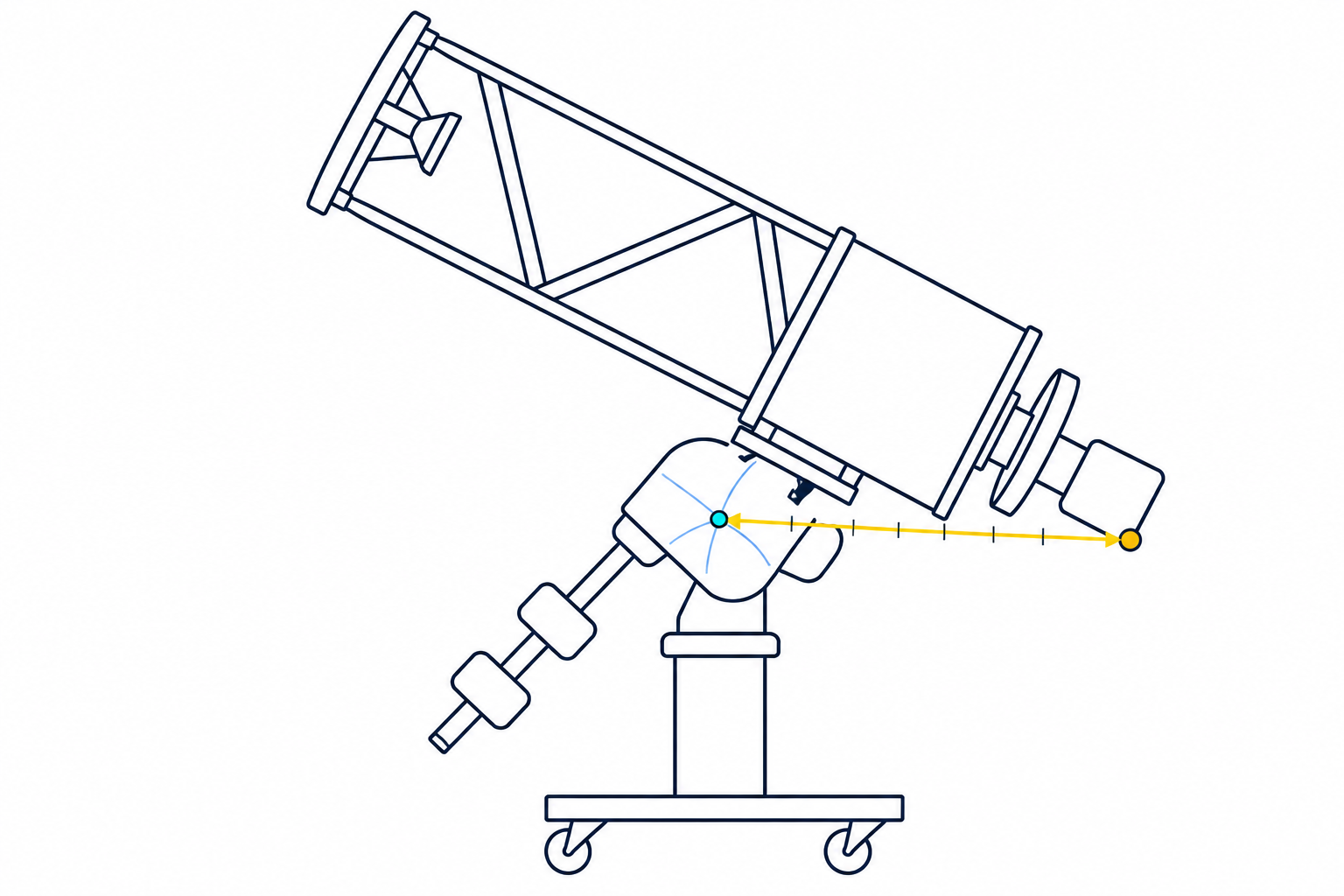
Swing diameter is twice the longest distance from the mount's center of rotation to the furthest part of the rig. On a German equatorial mount, the center of rotation is where the RA and Dec axes meet. On an alt-az fork or direct-drive mount, measure from where the two axes cross. Then add 1 to 2 in (25 to 50 mm) for cable slack and focuser travel.
Here's a worked example with made-up measurements, so you can see how the number moves. Use your own tape measure, not these figures.
| Rig (example measurements) | Longest reach from axes | x 2, plus 2 in slack | Kit |
|---|---|---|---|
| 20 in reflector, compact camera and filter wheel | 38 in | 78 in | Extra-Large (up to 86 in) |
| 24 in reflector, camera, filter wheel and rotator | 41 in | 84 in | Extra-Large (up to 86 in) |
| 24 in reflector with a long instrument stack or extended counterweight shaft | 45 in | 92 in | Custom (86 in or more) |
Measure the worst case. On a German equatorial mount, that's often the counterweight end of the shaft rather than the front of the tube. On a fork, it's usually the instrument package at the back of the optical tube as it swings past the base. The Plans and Pricing page has a swing diameter calculator if you'd rather enter the numbers there.
What plate scale suits a site with 1.4 to 1.9 arcsec seeing?
Aim for roughly 0.45 to 0.95 arcsec per pixel, which puts 2 to 3 pixels across a star at the site's median seeing. On a 0.5 m class telescope, that usually means binning a small-pixel CMOS camera 2x2 or 3x3, or using a large-pixel camera at 1x1.
Plate scale in arcsec per pixel is 206.265 times the pixel size in microns, divided by the focal length in millimeters. The PlaneWave CDK24 has a 610 mm aperture at f/6.5 (3,962 mm focal length), and the CDK20 is 508 mm at f/6.8 (3,454 mm). With a full-frame 3.76 micron sensor and a 9 micron sensor, the numbers work out like this:
| Telescope | Pixel size | Bin 1x1 | Bin 2x2 | Bin 3x3 |
|---|---|---|---|---|
| CDK20 (3,454 mm) | 3.76 micron | 0.22"/px | 0.45"/px | 0.67"/px |
| CDK20 (3,454 mm) | 9 micron | 0.54"/px | 1.07"/px | n/a |
| CDK24 (3,962 mm) | 3.76 micron | 0.20"/px | 0.39"/px | 0.59"/px |
| CDK24 (3,962 mm) | 9 micron | 0.47"/px | 0.94"/px | n/a |
Unbinned 3.76 micron pixels at these focal lengths oversample even our best nights, so you'd store four to nine times the data for no extra resolution. Binned 2x2, the CDK20 sits at 0.45"/px, a good match for the 40 to 45 nights a year when seeing drops under 1.3 arcsec. Binned 3x3, both telescopes suit the median nights.
Field of view matters too. A 36 x 24 mm sensor covers about 36 x 24 arcmin on the CDK20 and 31 x 21 arcmin on the CDK24. That's comfortable for most galaxies, compact clusters and photometry fields with enough comparison stars, and tight for large nebulae. The seeing data behind these numbers is summarized on our Why Choose Us page.
How many observing hours does a research program get in a year?
Plan around the published roof-open log rather than clear-night counts. As of October 2026, our Site Conditions page showed about 2,400 roof-open hours in a typical 365 days, logged live since July 2023.
Clear nights (over 286 a year as a site average) tell you how often the sky cooperates. Roof-open hours tell you how much dark, usable time a telescope actually got. For grant planning and student scheduling, the second number is the one to build on.
A simple allocation example: a telescope shared by three research groups, split evenly, gives each group roughly 800 hours a year to work with. Take out time for calibration frames, pointing model updates and the occasional maintenance night, and budget the rest. If one group runs time-critical work (transit timing, occultations, target-of-opportunity follow-up), give it priority windows in the scheduler and let the survey work fill around it.
Check the live page before you put a number in a proposal, and cite the date you read it.
How does a large telescope run unattended every night?
It runs from a scheduler on the pier computer that knows the roof state, the targets, their constraints and their priority. Your team writes the plan; the software executes it, and someone on your side reviews the logs each morning.
For multi-target and multi-user queues, many groups pair NINA's Advanced Sequencer with the free Target Scheduler plugin, which picks the best target for the conditions each night and tracks how much data each project has. TheSkyX and SGP suit simpler single-group programs. We support NINA, SGP, ACP and TheSkyX. Whatever you pick, set it up so that a lost connection or a closed roof parks the telescope safely and the night resumes cleanly when conditions return.
Data volume is the part teams underestimate. A 61 megapixel full-frame camera writes about 122 MB per unbinned 16-bit frame. A long winter night of 150 to 200 frames is 18 to 24 GB. Binning 2x2 in camera cuts that by four. Many groups calibrate and plate-solve on the pier computer and move reduced frames home, then pull raw frames only when they need them.
Our site runs on a dedicated multi-dish Starlink connection (quad-dish, expandable to eight dishes). If your project has specific network or data-handling needs, Ed works those out with each institution.
What does DSP Remote take care of for a hosted research telescope?
We look after the building, the pier, the roof, power protection, internet and the physical care of the telescope. Your team runs the science, the software and the data.
On our side, every hosted telescope gets:
- A custom pier in a fully enclosed bay, with automated roll-off roofs and roof status sent by email or push notification.
- Surge protection and 24/7 live observatory camera feeds, with optional extra angles and room for your own pier camera.
- Telescope inspection and cleaning every eight weeks, including dust removal and cable checks.
- Remote power cycling and system recovery, plus help with firmware and software updates. Scope and mount swaps are available, and additional charges may apply.
- Owner-run support with no ticket queue. Most requests are answered in as little as 15 minutes, up to 24 hours.
Installation can go either way. Our concierge install ($500 one-time, or included with select packages) covers full rig setup, cabling, power, camera alignment, flat panel mounting, a collimation check and initial software configuration. If your faculty or engineers want to install it themselves, there are on-site tools and workspace, and a free bunkhouse with a full kitchen, bathroom and two bedrooms (reservations required). Details are on our Install and Maintenance page.
For institutions, we offer formal service agreements and grant-ready documentation. Pricing for multi-pier projects, agreement terms, access for your team, data policies and the largest instrument a pier can take depend on the project, and Ed sets those out with you directly.
We're also building Observatory 21, a second large observatory beside Observatory 20. As of September 12, 2026, the steel frame, roof and wall panels were up and the slab was poured, with the interior still an empty shell. We haven't published its pier count or size limits yet, but you can contact Ed now to get on the list for opening day.
How should you prepare a large telescope before it ships?
Run the complete system on your own site first, under the same software and cabling it will use at the pier. Everything you fix on campus is something nobody has to fix remotely at 2 a.m.
A shakedown checklist for a 0.5 m class rig:
- Run at least three full unattended nights with the final scheduler, camera, focuser, rotator and filter wheel.
- Build and save a pointing model, and confirm the mount parks and unparks cleanly after a power cycle.
- Route every cable through the mount with the axes at their extremes, and note the worst-case swing.
- Label both ends of every cable and photograph the wiring before you take anything apart.
- Write a one-page system document: equipment list with serial numbers, power draw per device, network addresses, software versions and who on your team to call.
- Pack a spares box: fuses, a spare USB hub, spare cables and any parts with a long lead time.
- Arrange equipment insurance through your institution's risk office. Members carry their own policy; a personal articles policy typically runs about $1 per $1,000 of equipment per month.
Our earlier post on how to ship a telescope mount covers crating and freight. For an optical tube this size, also follow the manufacturer's own shipping guidance for the primary mirror.
Frequently asked questions
What is the largest telescope DSP Remote can host?
Our published Extra-Large Kit covers refractors or reflectors up to 24 in with a swing up to 86 in. Custom Kits start at 86 in of swing. For anything larger or heavier, Ed works out fit with each institution.
How much does it cost to host a 0.5 m telescope?
Most 20 to 24 inch rigs fall in the Extra-Large Kit at $550 a month or a Custom Kit from $550 a month. Concierge installation is $500 one-time. For several piers, contact Ed about your project.
Can a PlaneWave telescope be hosted at DSP Remote?
Yes. PlaneWave is among the supported brands, along with ASA, 10Micron, Astro-Physics and Software Bisque. Ed also owns Deep Space Products, which sells PlaneWave telescopes including the CDK20 and CDK24.
What plate scale should a 0.5 m telescope use at a Bortle 1 site?
Around 0.45 to 0.95 arcsec per pixel for median seeing of 1.4 to 1.9 arcsec. With 3.76 micron pixels on a CDK20 or CDK24, that means binning 2x2 or 3x3.
Does DSP Remote provide paperwork for a grant proposal?
Yes. We offer grant-ready documentation and formal service agreements for institutions. Contact Ed with your project details and timeline.
Can our team install the telescope ourselves?
Yes. Self-installers get on-site tools and workspace and a free bunkhouse (reservations required). Our concierge install is the alternative at $500 one-time.
Talk to Ed about an institutional agreement
If you're scoping a 0.5 m class telescope, or several piers, for a research program, send Ed the instrument list, your swing measurement and your timeline. He'll work through fit, the agreement and the documentation your grant office needs. Talk to Ed about an institutional agreement.