
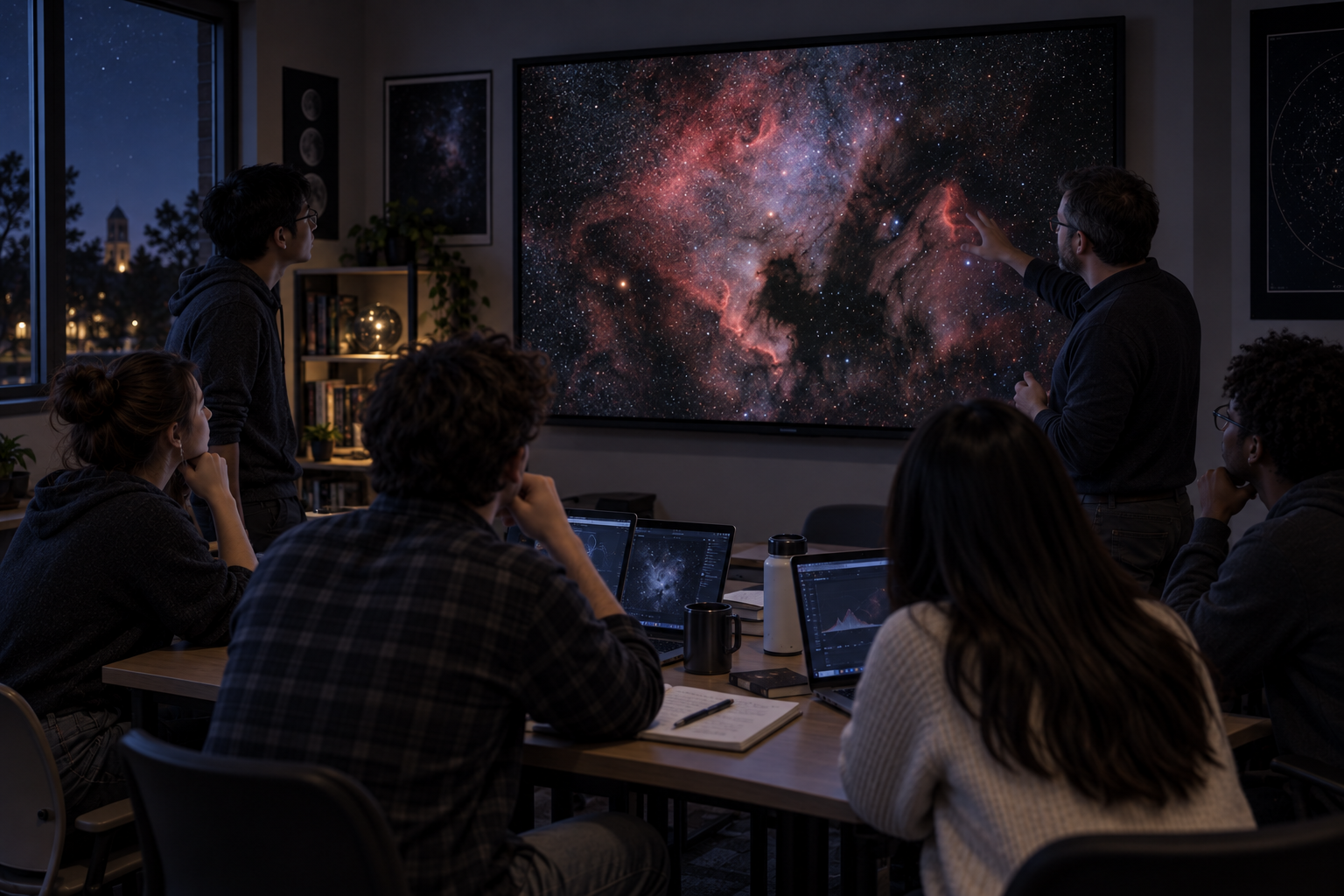
A student remote observing program gives a class scheduled time on a real research-grade telescope at a dark site, operated over the internet from campus. One hosted telescope can support a full class each semester if you split students into small groups, give each group one well-chosen project, and run requests through a queue instead of live sessions. Here's how to plan the projects, the night budget, the equipment and the yearly cost, using DSP Remote as the worked example.
This is written for the faculty member or department chair who has to make the program run, not just propose it. If you're still deciding whether to host a telescope at all, start with our earlier post on planning a remote observatory for a university.
Quick facts
- DSP Remote is near Animas, New Mexico, at 4,240 ft under true Bortle 1 skies, with over 286 clear nights a year (site average).
- Median seeing is 1.4 to 1.9 arcsec FWHM at zenith in our spot checks during real imaging sessions.
- We serve educators, research teams, and commercial and government projects, with formal service agreements, grant-ready documentation and multi-pier discounts for institutions.
- Roll-off roofs open and close automatically based on conditions and time of day, and roof status goes out by email or push notification.
- Every hosted telescope is inspected and cleaned every eight weeks, with dust removal and cable checks.
- Supported software includes ACP, NINA, SGP and TheSkyX.
What is a student remote observing program?
It's a course or lab sequence in which students plan observations, submit them to a telescope they never touch, and analyze the data that comes back. The telescope sits at a dark site; the students work from a classroom, a lab or their own laptops. The science is real because the data is real.
Most programs fall into one of two models. In the live model, a group logs in during the night and drives the telescope with an instructor watching. In the queue model, students submit an observing plan by a deadline, the scheduler runs it on the first suitable night, and the files arrive the next morning. Live sessions are memorable, but they collide with class schedules, sleep and weather. The queue model is what lets one telescope serve dozens of students, and it's how most professional observatories work anyway.
Why put a teaching telescope at a dark site instead of on campus?
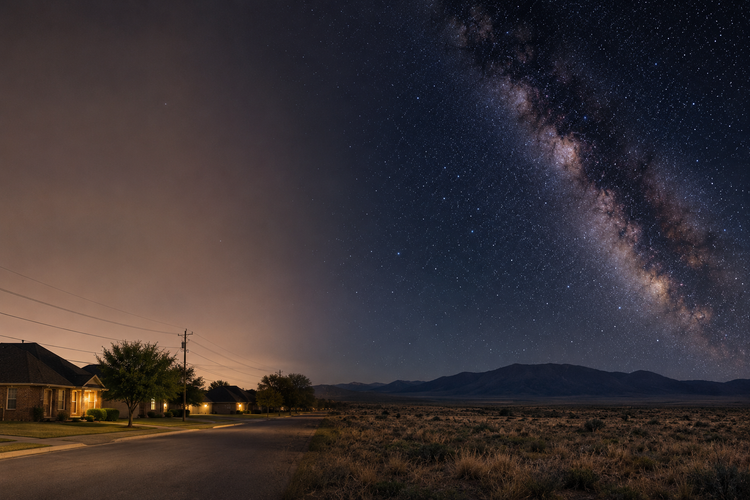
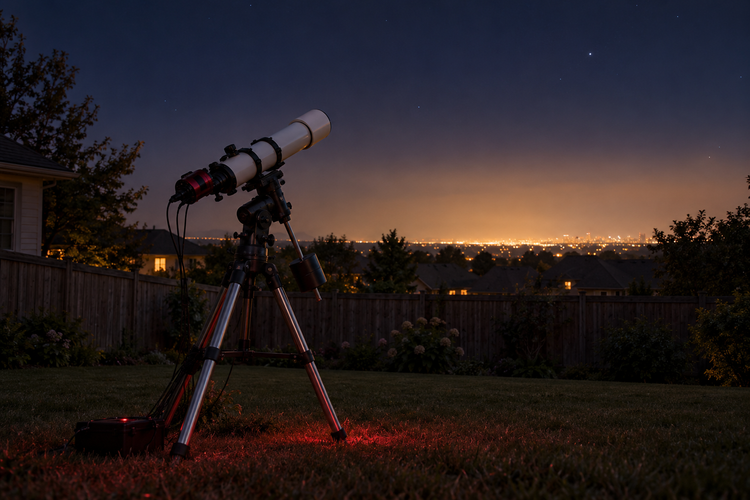
Because a campus telescope under Bortle 7 or 8 skies spends most of its time fighting sky glow and clouds, and students learn more from clean data than from troubleshooting. A dark, dry site gives every group a usable data set inside a single semester.
Sky background is the main noise source for faint targets. Under a Bortle 1 sky, the background is roughly 20 to 40 times fainter than under Bortle 7 or 8, so a student reaches the same signal-to-noise ratio on a faint galaxy or a 15th magnitude variable star in a fraction of the exposure time. Our side-by-side M101 comparison shows what that difference looks like on the same target.
The second reason is reliability. A campus rooftop dome needs someone to open it, close it, and notice when weather turns. At DSP Remote the roll-off roofs open and close based on conditions and time of day, so the scheduler never has to depend on a student remembering to close up at 3 a.m.
What projects can students complete in one semester?
The best student projects have a clear question, a known target list and a data set small enough to finish analyzing before finals. Photometry and astrometry projects fit that brief better than pretty-picture imaging, and they produce results students can submit to real databases.
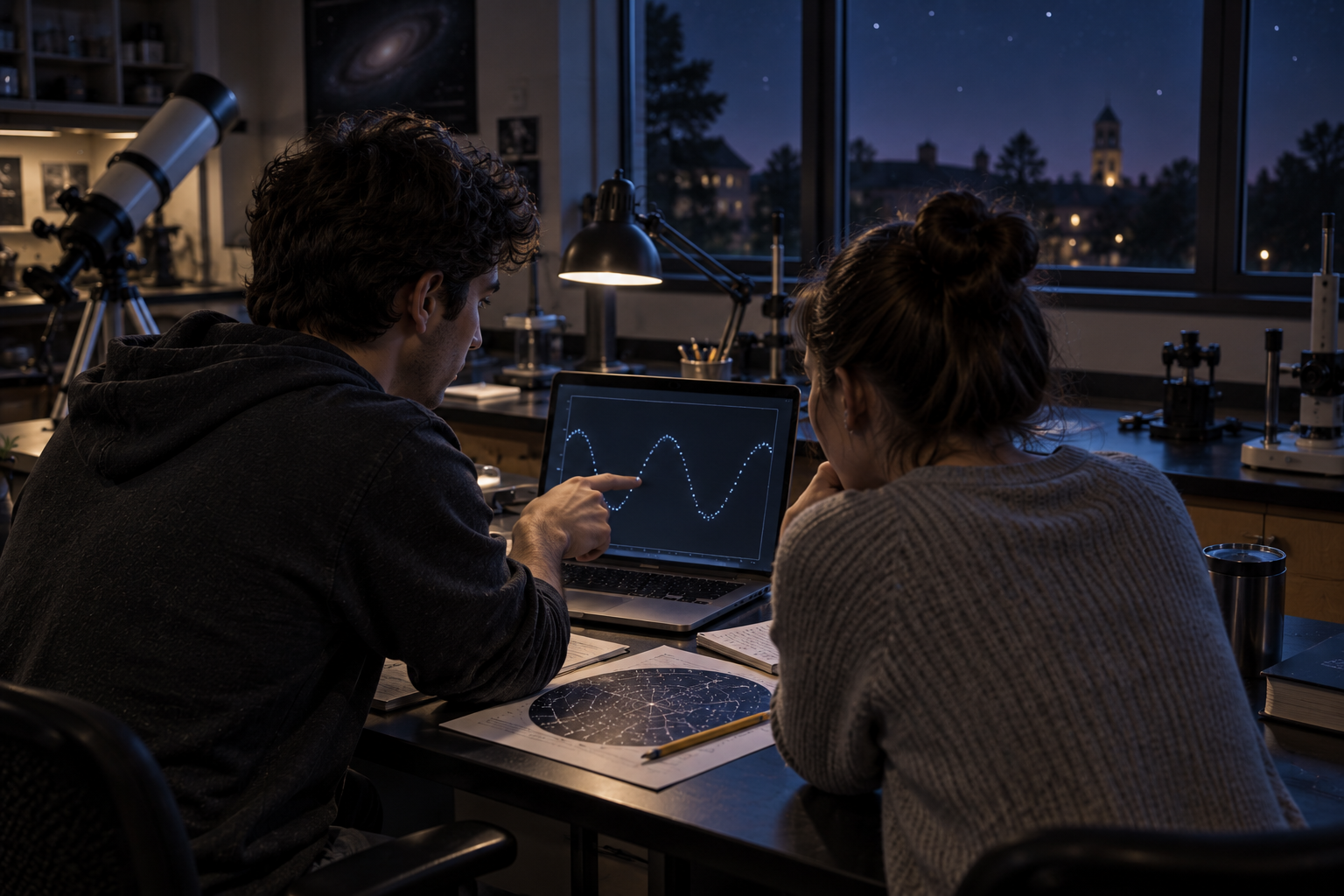
Here are five projects that work well on a single hosted telescope, with a realistic night budget for each:
| Project | What students measure | Clear nights needed | Where results can go |
|---|---|---|---|
| RR Lyrae light curve | Brightness over one full pulsation (periods are roughly half a day) | 1 to 2 | AAVSO database |
| Eclipsing binary timing | Time of minimum light compared with the published ephemeris | 1 per eclipse, 2 to 3 total | AAVSO database |
| Exoplanet transit | Depth and timing of a known transit, 2 to 4 hours plus baseline | 1 per transit, plan for 2 attempts | Class report, citizen science archives |
| Asteroid astrometry | Positions of a main-belt asteroid on two or more nights | 2 to 3 | Minor Planet Center |
| Galaxy color and structure | Multi-filter imaging and surface brightness profiles | 2 to 4 | Class report or poster |
Projects that end in a submission give students something to point to later. The AAVSO accepts variable star photometry from students and amateurs, and the Minor Planet Center accepts asteroid astrometry and assigns an observatory code to new sites. Both have guides your students can follow on their own.
How many observing nights does a class actually get?
At DSP Remote's site average of over 286 clear nights a year, a 15-week semester (105 nights) works out to roughly 80 clear nights on paper. Real semesters vary by season, so plan your syllabus around about half of that and treat the rest as margin.
Here's a worked example for a class of 24 students in eight groups of three:
- 105 nights in the semester, about 80 clear at the annual average.
- Plan on 40 usable nights after weather variation and moon phase.
- At 8 to 11 hours of astronomical darkness a night during the school year, that's roughly 320 to 440 hours of dark sky.
- Split across eight groups, each group's share is 40 hours or more, which is far more than any project in the table above needs.
The arithmetic says one telescope has room for more than one class. In practice, the limit is the scheduling deadline, not the sky. If every group submits in week ten, the queue backs up. Stagger submission deadlines across the semester and the telescope stays busy every clear night.
Check the live roof-open hours on our Site Conditions page before you build the calendar. It's also a good page to show students on the first day, because it turns "weather permitting" into numbers they can read.
How do you schedule many student requests on one telescope?
Use a queue. Students submit a structured observing plan (target, filters, exposure time, number of frames, timing constraints), the instructor approves it, and scheduling software decides when it runs. Nobody needs to be awake for it.
ACP with its Scheduler add-on is built for this, with multiple observers submitting requests to one telescope. NINA with the Target Scheduler plugin is a lighter option that works well when one instructor manages the queue for the whole class. TheSkyX and SGP can run sequences too, but they're less suited to many independent users.
A simple workflow that holds up through a semester:
- Week 1 to 2: students learn the target, calculate when it's well placed, and estimate exposure from a signal-to-noise target.
- Week 3: the instructor reviews each plan against the queue and checks for conflicts (two groups wanting the same transit window, for example).
- Weeks 4 to 12: plans run on the first suitable night. Set up an email to each group when its data lands.
- Weeks 10 to 15: reduction, analysis, and submission to AAVSO or the Minor Planet Center where it applies.
Keep a shared calibration library (master darks, flats and bias frames at each camera setting) so students spend their time on science, not on rebuilding calibration frames every night.
What telescope and camera setup works for teaching?
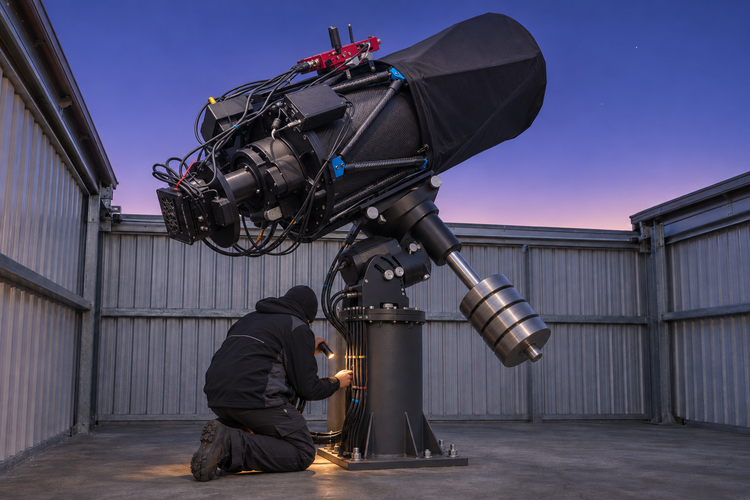
A 14 to 17 inch reflector on a premium mount, with a cooled monochrome CMOS camera and a filter wheel, covers every project above. It's large enough for 16th to 17th magnitude photometry in reasonable exposures and small enough to run without a dedicated technician.
A common choice is a PlaneWave CDK14 or CDK17 on a 10Micron GM2000 or GM3000, with a camera such as a ZWO ASI6200MM and a set of photometric filters (Johnson-Cousins B, V and R, or Sloan g', r' and i'). The 10Micron's absolute encoders and pointing model help in a teaching setup because the mount keeps its position through a power cycle and tracks unguided, which removes two common reasons a student's night fails.
At DSP Remote, plans are priced by swing diameter. A CDK17-class reflector on a premium mount usually fits the Large Kit ($500/mo, swing up to 74 in). A larger reflector on a GM3000 or GM4000-class mount usually fits the Extra-Large Kit ($550/mo, swing up to 86 in). Larger systems go in a Custom Kit ($550/mo and up). The swing diameter calculator on our Plans and Pricing page tells you which one your rig needs.
What does DSP Remote handle, and what does your department run?
We look after the site and the physical care of the telescope. Your department owns the instrument, the software, the student accounts, the observing queue and the data. Where a program needs something beyond our published services, Ed works it out with each institution directly.
On our side, every hosted telescope gets a custom pier in a fully enclosed bay, surge protection, a dedicated multi-dish Starlink connection (quad-dish, expandable to eight dishes), and an inspection and cleaning every eight weeks. Remote power cycling and system recovery, help with firmware and software updates, and scope and mount swaps are available (additional charges may apply). Members get 24/7 live observatory camera feeds and can add their own pier camera, which is a good way to let students see the telescope they're using.
Support is owner-run with no ticket queue. Most requests are answered in as little as 15 minutes, up to 24 hours. For installation, our concierge install ($500 one-time) covers rig setup, cabling, power, camera alignment, flat panel mounting, a collimation check and initial software configuration. Faculty who'd rather install it themselves can use on-site tools and workspace and stay in our free bunkhouse (reservations required). The details are on our Install and Maintenance page.
How students connect to the telescope computer, and how data moves to campus storage, are part of the conversation Ed has with each institution, along with the terms of the service agreement. Bring your IT contact to that conversation early.
What does a student observing program cost to run for a year?
At published rates, hosting one teaching telescope on a Large Kit costs $6,000 a year, plus a one-time $500 if you choose the concierge install. Insurance and shipping are separate, and multi-pier discounts are available for institutions.
| Line item | Calculation | Year one |
|---|---|---|
| Large Kit pier | $500/mo x 12 months | $6,000 |
| Concierge install (optional) | One-time | $500 |
| Equipment insurance, example | About $1 per $1,000 of equipment per month, on a $50,000 rig | About $600 |
| Total before shipping and software | About $7,100 |
If the telescope serves two classes of 24 a year, that's under $150 per student in year one, and less after that once the install is paid. Members can carry a personal articles policy through their own agent; for a college, that usually means the risk management office. Terms are 6 or 12 months with the rate locked for the term, or single and multi-year agreements, and we accept check, money order, wire transfer or Zelle.
For a grant budget, our Why Choose Us page has the institutional overview and seeing data that reviewers tend to ask about, and we provide grant-ready documentation for institutions.
Frequently asked questions
Can high school students use a remote research telescope?
Yes, if the program uses a queue. Students submit an approved observing plan and receive the data, so they never need to operate the telescope live or stay up at night.
How many students can share one hosted telescope?
One telescope can comfortably serve a class of 24 in eight groups each semester, and the night budget leaves room for a second class. The practical limit is how well submission deadlines are staggered.
What software do schools use to schedule a remote telescope?
ACP with its Scheduler add-on is designed for many observers sharing one telescope. NINA with the Target Scheduler plugin works well when one instructor runs the queue. DSP Remote supports ACP, NINA, SGP and TheSkyX.
How much does it cost to host a teaching telescope at DSP Remote?
A CDK17-class rig on a premium mount usually fits the Large Kit at $500 a month. The optional concierge install is $500 one-time. Multi-pier discounts are available for institutions.
What student projects produce real scientific data?
Variable star photometry and eclipsing binary timings can be submitted to the AAVSO, and asteroid astrometry to the Minor Planet Center. Exoplanet transit timing is another good one-night project.
Talk to Ed about an institutional agreement
If you're planning a student observing program for next semester or next year, the first step is a conversation about your telescope, your class sizes and how your team will connect. Contact Ed to talk about an institutional agreement, including multi-pier options and grant-ready documentation.